Solar Water Pump Sizing Guide: How to Match Pump, Panel, and Storage
This guide walks through the sizing methodology step by step, using a real-world irrigation example. Vodloon offers solar pumping solutions for off-grid living, irrigation, livestock, and pool circulation — each with different sizing requirements.
Step 1: Define Your Water Requirements
Everything starts with how much water you need, how deep you're pumping it, and how far it needs to travel. Gather these four numbers:
| Parameter | What It Means | Example |
|---|---|---|
| Daily Water Volume (Q) | Total water needed per day (liters or m³) | 20,000 L (20 m³) for 2 ha irrigation |
| Static Head (Hs) | Vertical distance from water surface to pump outlet | 30 m (borehole depth) |
| Dynamic Head (Hd) | Additional head from friction in pipes + delivery height | 10 m (pipe friction + 5m tank height) |
| Pumping Hours | Effective solar pumping window per day | 5–6 hours (peak sun) |
Total Head (H) = Static Head + Dynamic Head. In our example: 30 + 10 = 40 m.
Quick reference — daily water needs by application:
Drip irrigation (1 ha): 5,000–10,000 L/day · Sprinkler irrigation (1 ha): 20,000–40,000 L/day · 50 cattle: 2,500–5,000 L/day · Pool circulation: 8,000–15,000 L/day (varies by pool size)
Step 2: Calculate Required Pump Power
The hydraulic power needed to lift water is calculated using the formula:
P_hydraulic (W) = (Q × H × ρ × g) / (η × 3600)
Where:
Q = flow rate (L/h) = Daily volume / Pumping hours
H = total head (m)
ρ = water density (1 kg/L)
g = gravity (9.81 m/s²)
η = pump + motor efficiency (typically 0.40–0.55 for solar pumps)
3600 = conversion from seconds to hours
Our example:
Q = 20,000 L / 5 hours = 4,000 L/h
P = (4000 × 40 × 1 × 9.81) / (0.45 × 3600) = 1,569,600 / 1,620 = ~970 W
So the pump needs approximately 1 kW of hydraulic power. But this is the power delivered to the water — the electrical input to the pump motor must account for motor and controller efficiency. With a typical motor efficiency of 85% and MPPT controller efficiency of 95%:
P_electrical = 970 / (0.85 × 0.95) = ~1,200 W
Step 3: Size the Solar Array
The solar array must deliver enough power to drive the pump during the effective pumping window. The array should be oversized by 1.3–1.5× to account for:
- Panel degradation (~0.5%/year) — size for year-10 output, not day-1
- Temperature derating — panels lose 0.3–0.4% efficiency per °C above 25°C
- Dust and soiling — 5–15% loss in real-world conditions
- Wire and connection losses — 2–3%
Array size = P_electrical × 1.4 (derating factor)
Array size = 1,200 × 1.4 = 1,680 Wp
Using 450W monocrystalline panels: 1,680 / 450 = 3.7 → round up to 4 panels (1,800 Wp).
| Configuration | Voltage | Current |
|---|---|---|
| 4 panels × 450W in series | 4 × 41V = 164V (Voc) | 11.5A (Isc) |
| 2S × 2P (2 series, 2 parallel) | 2 × 41V = 82V | 2 × 11.5A = 23A |
Check the pump controller's MPPT voltage range. If the controller accepts 60–150V, use the 2S×2P configuration. If it accepts 100–250V, use 4S. The key rule: panel Voc must be within the controller's range under all temperature conditions (Voc increases in cold weather).
Step 4: Storage for Cloudy Days
Solar pumps without storage only run when the sun shines. On cloudy days, output drops 50–80%, and on overcast days, the pump may not start at all. There are two strategies to handle this:
Strategy A: Oversized Storage Tank (Preferred)
Instead of storing electricity in a battery, store water in an elevated tank. Size the tank for 3–5 days of water demand. On sunny days, the pump fills the tank; on cloudy days, gravity feeds water from the tank. This approach is far cheaper than battery storage and has zero maintenance.
Tank size = Daily volume × 3 days = 20,000 × 3 = 60,000 L (60 m³)
Strategy B: Battery Storage
When an elevated tank isn't feasible (flat terrain, no height advantage), use battery storage to run the pump during cloudy periods. The battery needs to store enough energy for 1–2 days of pumping:
Battery size = P_electrical × Pumping hours × Days of autonomy / DoD
= 1,200 W × 5 h × 1 day / 0.90 = ~6,700 Wh (6.7 kWh)
A 48V LiFePO4 battery at 6.7 kWh = 140 Ah. This is modest and affordable. For 2 days autonomy, double it to ~14 kWh.
Step 5: Select the Right Pump Type
| Pump Type | Best For | Head Range | Flow Range |
|---|---|---|---|
| Submersible (DC) | Deep boreholes (irrigation, livestock, off-grid living) | 20–200 m | 0.5–20 m³/h |
| Surface (DC) | Shallow wells, rivers, ponds | 5–30 m | 2–30 m³/h |
| Pool Circulation | Swimming pool filtration and circulation | 2–15 m | 5–25 m³/h |
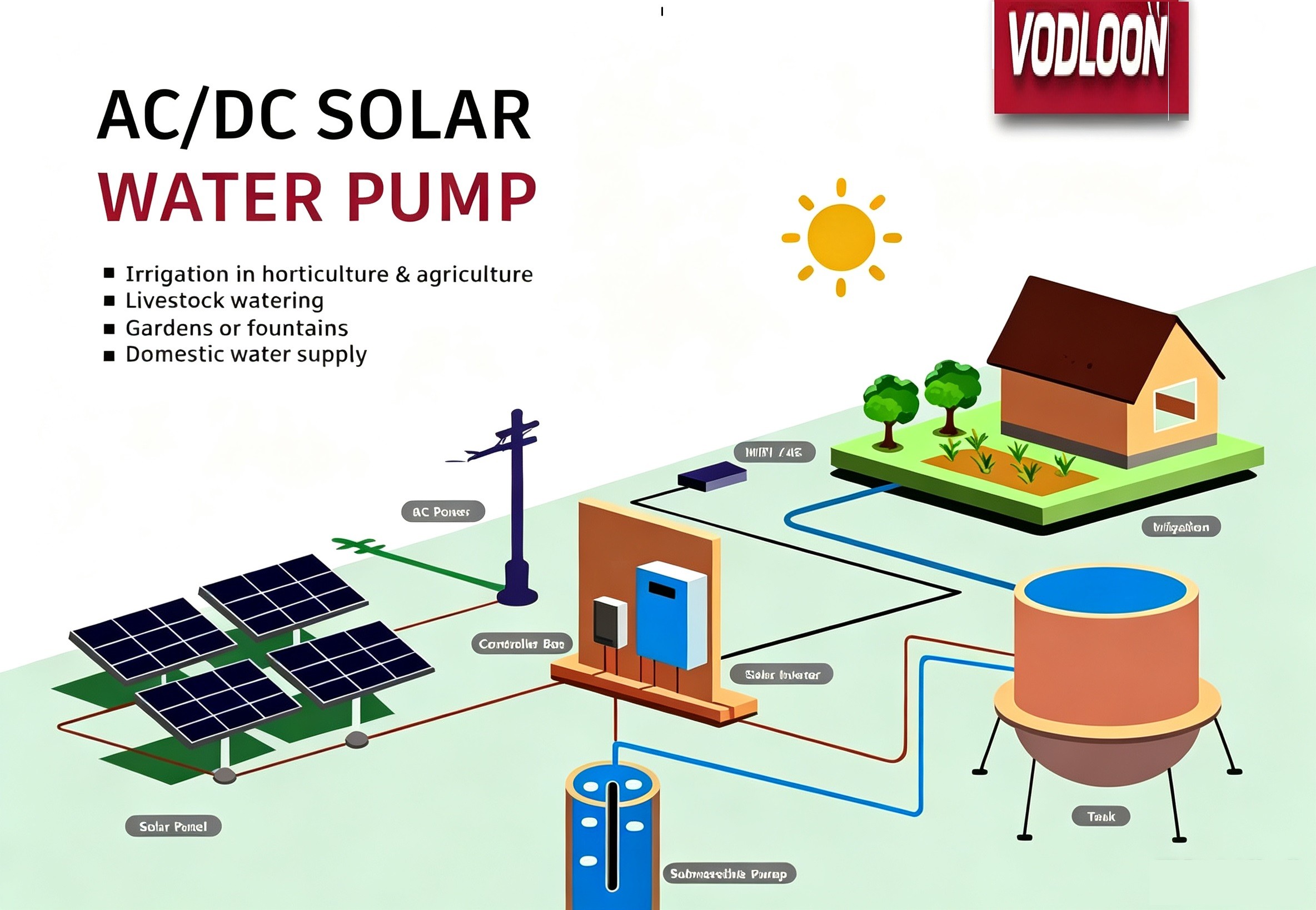
| AC + Solar Inverter | High-power applications (>3 kW) | Any | Any |
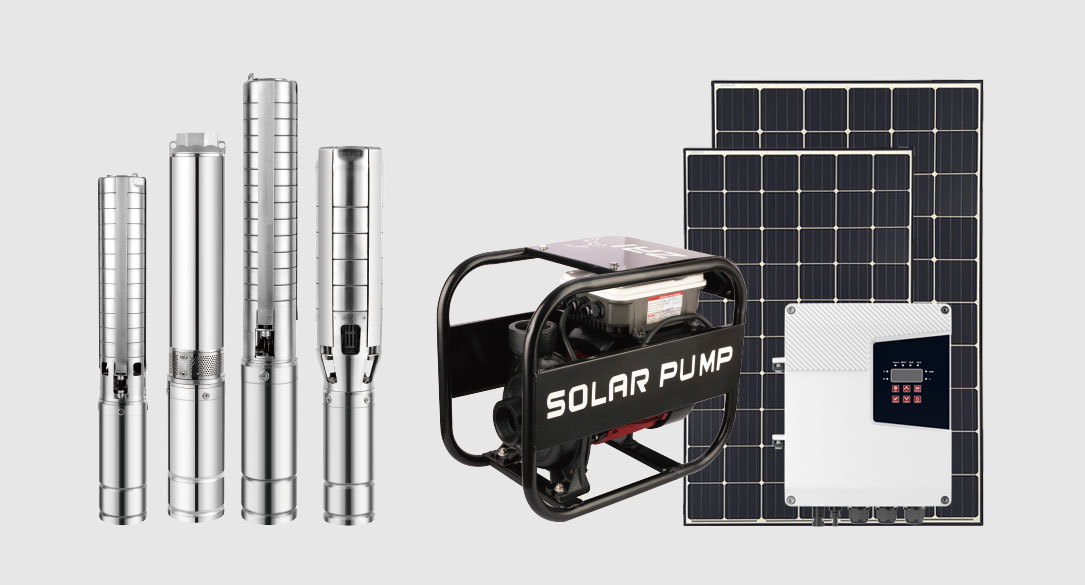
For our example (40 m head, 4 m³/h flow), a DC submersible pump rated at 1–1.5 kW is the correct choice. For higher power (>3 kW), use a standard AC submersible pump paired with a solar pump inverter (VFD) that converts DC from panels to AC for the motor.
Vodloon Solar Pump Applications
- Solar Pump for Off-Grid Living — complete water independence for remote homes and cabins
- Solar Pump for Irrigation — drip and sprinkler systems for farms and orchards
- Solar Pump for Livestock — reliable water supply for cattle, sheep, and poultry in remote pastures
- Solar Pump for Pool Circulation — energy-free pool filtration powered by the sun
- Full system supply — pump, controller, panels, sensors, and installation guidance
 Complete System Summary
| Component | Specification |
|---|---|
| Application | 2 ha drip irrigation, 30m borehole |
| Daily Water Demand | 20,000 L (20 m³) |
| Total Head | 40 m |
| Pump | 1.2 kW DC submersible, 4 m³/h at 40m |
| Solar Array | 4 × 450W panels = 1,800 Wp |
| Controller | MPPT solar pump controller (60–150V DC input) |
| Storage | 60,000 L elevated tank (3-day autonomy) |
| Estimated Cost | $3,000–$5,000 (complete system) |
With zero operating cost (no fuel, no grid connection) and a 25-year panel lifespan, the system pays for itself in 2–3 years compared to diesel pumping — and delivers water reliably for decades.
Proper sizing is the difference between a solar pump that runs flawlessly for 15 years and one that frustrates you every cloudy day. Follow these steps, or let Vodloon's engineering team do the calculations for you.
Need help sizing your solar pump system? Explore Vodloon Solar Pumping Solutions →